AI needs to understand the world of human interactivity
The most powerful AI is trained on written words, which makes it amazing at solving problems that live in text: coding, math, research. Yet human interaction goes beyond the written word. It is a world of its own, with its own rules, states, possibilities, and failure modes. Future intelligent systems must interact just as competently as they solve problems, if not more. That makes human-shaped interaction the next frontier, but it is trickier than you might think.
The interactions we consider general or normal are actually very specific. They emerged over millennia of evolution, built from intent, action, and consequence, one social system layering on another within us and between us. The result feels like nothing: normal, boring, standard to us, but intricate and complex to generally evolve toward without a manual filled with rules, or explained examples.1Goldfeder, Wyder, LeCun & Shwartz-Ziv (2026), AI Must Embrace Specialization via Superhuman Adaptable Intelligence. Human intelligence “is not a universal competence engine” but “a collection of specialized capabilities shaped by constraints and selective pressures.”
today the interaction bar is low, and even that breaks
Because AI does not follow these rules and tries to grasp the rules of interaction from statistical probabilities, the bar for AI in interaction is and stays low. ChatGPT set it there in an initial launch, and the current forerunners (more flavored AI assistants like Poke or Tomo) lifted it only a little.
The breakages come in types:
1. Bland. Generic, flattened, samey, dopamine-laden sloppiness that kills the experience.
2. Unpredictable. Out-of-distribution, jailbreakable, saying the unsafe or off thing. A liability the brand wears.2Wei, Haghtalab & Steinhardt (2023), Jailbroken: How Does LLM Safety Training Fail? NeurIPS 2023: safety training fails by mismatched generalization, inputs far from the training distribution slip past it. Zou et al. (2023): universal adversarial suffixes that transfer across models.
3. Non-designable. It cannot be made a specific someone. Every deployment feels like the same model, and any personality you impose unravels back to the default, so you cannot build distinct experiences.3Li et al. (2024), Measuring and Controlling Instruction (In)Stability in Language Model Dialogs, COLM 2024: persona adherence decays within about eight turns as attention over the persona tokens fades. Choi et al. (2024), Examining Identity Drift in Conversations of LLM Agents: larger models drift more, not less.
4. Context rot and drift. The context rots, it loses lucidity, forgets, changes its mind, the persona erodes. No real relationship holds, and trust goes with it.4Laban et al. (2025), LLMs Get Lost in Multi-Turn Conversation (ICLR 2026 Outstanding Paper): performance drops about 39% from single-turn to multi-turn, and a model that takes a wrong turn does not recover.
5. Sycophantic. It slides toward whatever the user already believes, mirrors, tells you what you want to hear. Bad outcomes, and at the extreme, people spiraling.5Cheng et al. (2026), Science: models affirm users' actions about 50% more than humans do, including actions that are harmful. Ibrahim et al. (2026), Nature: training models for warmth raises sycophancy and cuts accuracy.
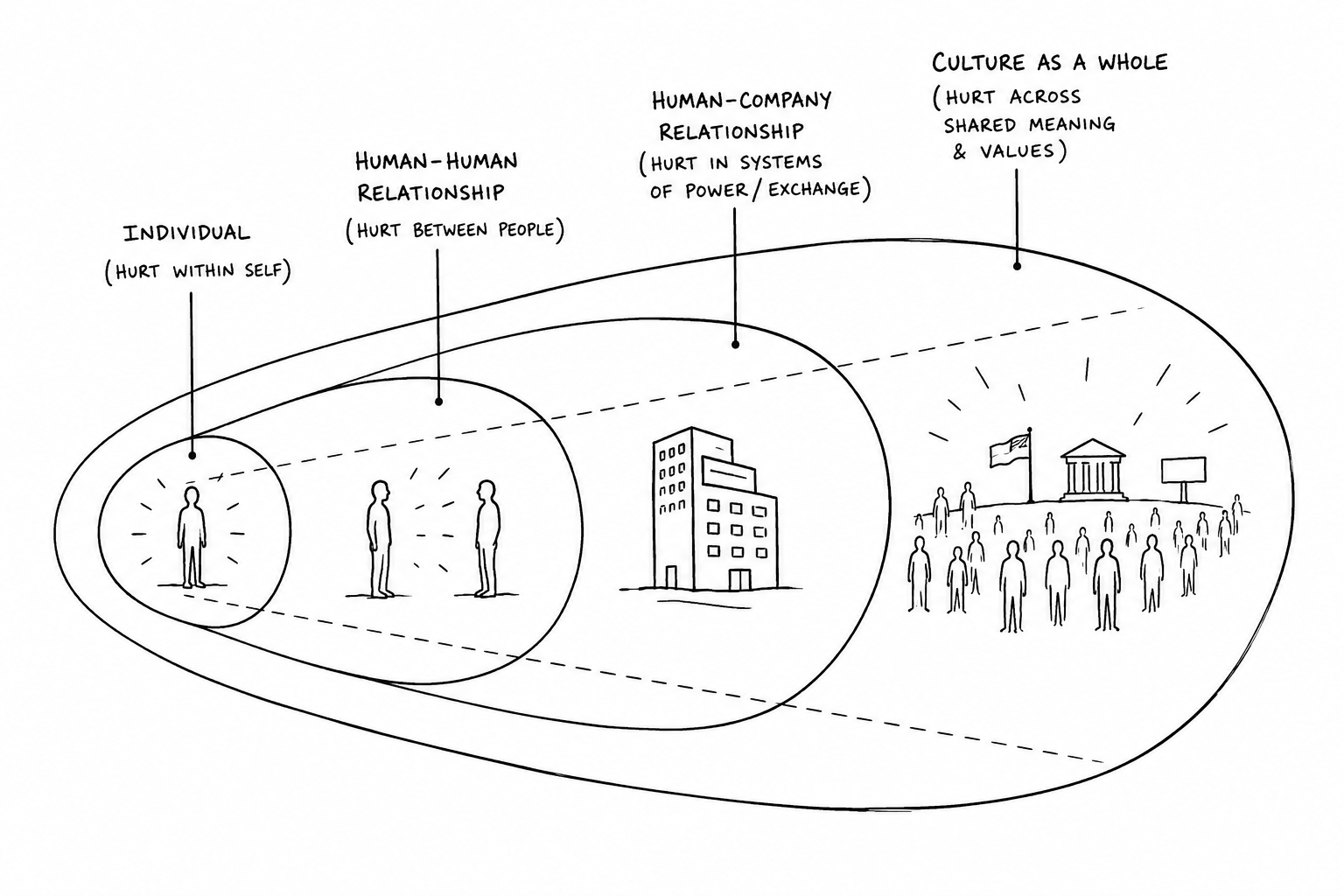
The hurt lands in four rings, from the self outward:
The individual. People who spend real time with AI shift in a bad direction: AI psychosis,6Hudon & Stip (2025), “Delusional Experiences Emerging From AI Chatbot Interactions or ‘AI Psychosis’,” JMIR Mental Health 12:e85799: sustained anthropomorphic chat can validate rather than challenge delusional beliefs in vulnerable users. atrophied skills, a lower EQ.
Between people. A self slowly reshaped by a partner that never plays by the social rules we project onto it,7We do project them: Nass, Steuer & Tauber (1994), “Computers Are Social Actors,” CHI '94, and Reeves & Nass (1996), The Media Equation. People apply human social rules to machines automatically, with no belief that the machine is human. Nass & Moon (2000), “Machines and Mindlessness”: the response is mindless, politeness, reciprocity, and stereotypes applied without deciding to. social skills erode, and the interactions between people take different shapes.
The company relationship. The system meant to represent a company feels alien to it instead. It commits social transgressions, erodes trust, cannot be controlled, and never quite reflects who the company is.
Culture. At scale it flattens us. One voice mediates billions of conversations, people mimic it, and the range of how we all speak and think narrows toward it.8Brinkmann et al. (2023), “Machine Culture,” Nature Human Behaviour 7:1855–1868: AI already participates in cultural evolution as a transmitter and shaper of the variation humans go on to select. Doshi & Hauser (2024), Science Advances: AI assistance raises individual story quality but narrows collective diversity. Yakura et al. (2024, Max Planck): ChatGPT-preferred words measurably spreading into human speech across ~360k talks and ~772k podcasts, “a closed cultural feedback loop.”
This leaves us locked out of the upside of good human-AI interaction. Done right, interaction could open a genuinely different regime, where AI can represent brands, help us interact and act with the world, make technology distinctly more human-shaped, and for the first time let the world we interact with reflect the world we evolved into. Companies could genuinely design the AI that speaks for them, instead of the trial-and-error prompting that is closer to a conjuring spell than a system. Broken, we stay stuck in the shallow optimum we are in now.
interaction is its own world with its own rules
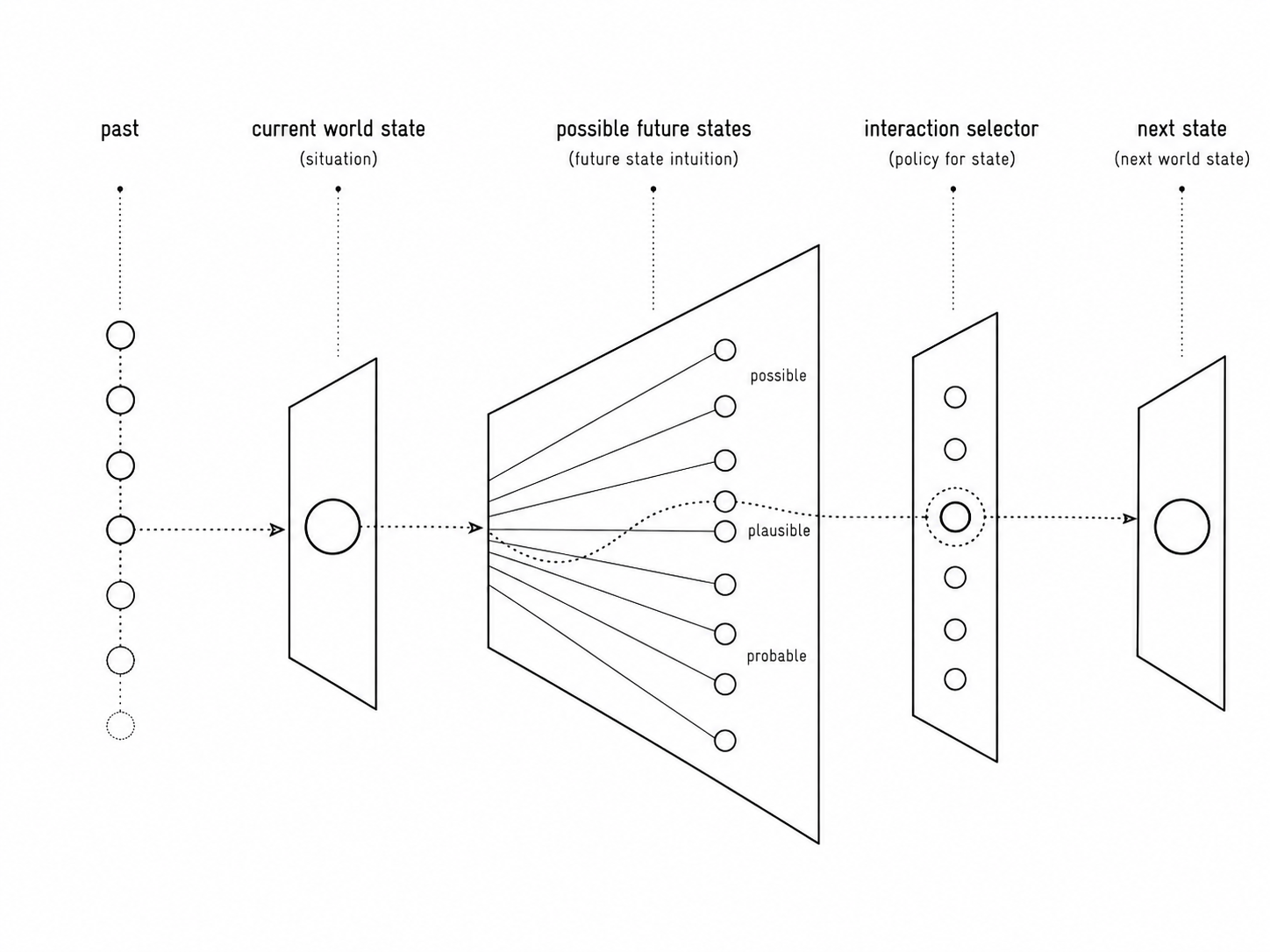
By “world model” we mean a model of the world of interaction: its situations, its legal moves, and how they follow one another. Not the spatial-temporal sense the term usually carries.9The usual sense: Ha & Schmidhuber (2018), “World Models”; LeCun (2022), A Path Towards Autonomous Machine Intelligence; Microsoft's WHAM/Muse (Nature, 2025). The same machinery, pointed at the space between people. For AI to leave this local-optimum illusion of interaction, it needs to internalize and respect the rules of human interaction, and for that it needs a world model of it, coming down to four things:
1. Situational awareness. Who it is, who it is with, and what has happened so far. This is the state of the interaction, and everything else depends on reading it right. The state has to be a real thing, clearly defined, and stable enough that it does not rot or degrade as the conversation runs. Most AI loses the thread here: its sense of the situation blurs and fades, until it is answering a conversation it is no longer in.10The rules the state is read against are documented machinery, not vibes: Sacks, Schegloff & Jefferson (1974) on turn-taking; Stivers et al. (2009), PNAS: a ~200ms median gap between turns across ten languages; Clark & Brennan (1991) on grounding; Grice (1975) on the cooperative principle.
2. Intuiting the possible moves. From the state it is in, only certain moves are legal under the rules of engagement, and each one leads somewhere. These are the dynamics of the world: what can happen next, and what follows if it does.11The exact thing world-model labs learn for physical space: WHAM/Muse (Microsoft, Nature 2025) learns gameplay dynamics from action-paired frames; General Intuition trains on roughly 2 billion clips a year of act-observe-act gameplay.
3. Selecting the best next move. A language model reaches for the average. A world model plans toward a goal. Which move is right depends on what you are trying to do, and what you are trying to do is something you can design.12LeCun (2022): the point of a world model is planning toward an objective, not predicting the likely next token. That difference is the whole difference between a policy and a language model.
4. Staying human-shaped. The reward in interaction is never a single good turn. It is being someone a person can rely on across the whole exchange: coherent, knowable, the same self at turn two hundred as at turn two.13Goldfeder, Wyder, LeCun & Shwartz-Ziv (2026): the specialists that produce long-horizon coherence are state-conditioned, not context-summed. Autoregressive error diverges with horizon; a carried state does not.
The first two are the world model itself: the situation and the moves, the state and its dynamics. The last two are what you do with it: which move to make, and who to be while making it. Together they form the rules of human engagement and the influences on which of the legal moves to make. What is left is a game-like world of human interaction.
we don't have the data to make AI understand how it interacts yet
We have built none of this world into AI yet. The lack hides in plain sight: models are tuned to satisfy us quickly, diverting interactions into the few shapes this AI can handle smoothly. We adapt to those few in-distribution behaviors, or the illusion pops. To have AI learn the interaction world, we need as much human-human interaction data as we can get, and we also need to gather proofs of AI breaking the interaction rules in AI-human settings.
The structured, labeled interaction data we would need, aligned to the state, moves, selection, and self ontology above, does not really exist at scale, because it seems too obvious to bother recording.14Polanyi (1966), The Tacit Dimension: we know more than we can tell. Gordon & Van Durme (2013), “Reporting Bias and Knowledge Acquisition”: what everyone knows is exactly what never gets written down, so it is missing from the data we train on. And where the field does label “dialogue state,” it means booking slots: MultiWOZ, the flagship state benchmark, tracks hotel-price and restaurant-area, and even those labels needed corrections on 17.3% of utterances (MultiWOZ 2.2). There is no highlight reel of a good interaction, no extensive record of how it works. We never catalogue or label it, and no one is paid to. So there are no large-scale datasets of the situations people are in, the next interactions open to them, or why they select the ones they do, and how those turn out, and no benchmark to hold one behavior against another.
The frontier of interactivity is locked by a lack of foundational labeled data. That lock keeps out better behavior and leaves us at this low bar.
But we figured out a way to patch the breakages, create benchmarks, and capture data in one motion. Maximally cheating in current systems to build a clean, better, human-shaped system of the future.
we fix current interactions
As mentioned, AI systems today have issues: no situational awareness, statelessness, context rot, no set self, no intuition for the next step. How can you even fix that without a world model? Simple: we emulate the inputs and outputs of a world model by observing interaction states on the fly and “guessing” possible next steps using faster (slightly dumber) LLMs, and injecting the relevant data into this.
Through our data efforts, we label the interaction as it happens, so we can feed the model an understanding of what is going on and how the moment relates to the ones before it. That is the situational awareness a stateless model never had. And we give it the senses a decision runs on: who it is, its role, the moment it is in, the same inputs a world model's policy would use to pick its next move. Emulating a world model from the outside, well enough to hold an interaction together today.
This meta approach has already broken benchmarks for interactions: it comes out more natural and more effective.15Natural: our response to the VERA voice benchmark (Lin et al. 2025), Pipeline Reasoning Breaks the Voice Accuracy Plateau. Raw models sit at VERA's ~10–15% plateau; the same models score 76–80% architected. Effective: on Sierra's τ²-bench (Barres et al. 2025), injecting the runtime interaction state lifts GPT-5.2 from 56.0 to 74.0 pass^4, with no change to the weights. And it is model- and modality-agnostic, because it is a harness for context injection. It replaces the novel-length system prompt, and it makes composite-model and task-allocation approaches easy.16In the same response paper, one pipeline runs a diffusion LM (Mercury-2), GPT-5.2, and Claude Opus 4.8 interchangeably. All three converge to 76–80% architected, and the cheap fast model holds the latency floor: task allocation in practice. It also allows for more designability, because people can nudge the initial aspects being injected.
Because we are labeling on the fly, we get to see every breakage live, even the ones usually not tracked. Those failures let us reflectively improve the harness, point to new directions for research, and build benchmarks for the common ones, where there are currently very few. The architecture is the audit: every deployment is a fix, a source of data, and a measuring instrument at once.
we capture and label interaction data to make better models
Cheating the system is a good incentive to label data at runtime, and that human-AI data is priceless for finding and measuring breakages. But it is AI behavior, not human, and it largely stays within distribution, limiting the natural flow of conversation. So it poisons the well you would train a real model from. Future systems need a golden dataset of genuine human-human interaction.
The ambition is to recognize and label interaction wherever it shows up, in video, in text, in games, in audio, on screens, and we build it surface by surface. At its core this is a labeling play, run several ways at once. We are creating and deploying a labeling framework on top of data we capture from free-floating, cheap, and self-captured records of people interacting with each other. The engine reads what is going on and compresses raw data, most of which is dirty, into clean tagged data ready for the next step. It is the same move the other world labs make: capture the data that unlocks an uplift which would otherwise be impossible.17WHAM/Muse (Microsoft, Nature 2025) captured action-paired gameplay to learn game dynamics. General Intuition captures roughly 2 billion gameplay clips a year for spatial-temporal dynamics. Interaction is the surface nobody is capturing.
We have built the first surface, the screen. On anything running on a screen, audio, video, movement, we can capture and label the interaction and track multiple moving actors across a scene. And because labeling forces us to interpret a scene the way a person would before acting, the same framework lets an AI actor respond to those inputs in kind. It reads the scene, then applies our two shortcuts: POV for the read, next-step for the move. see it here...
That is the lab. One arm fixing today's systems, incentivizing data labeling and building the benchmarks. The other capturing and labeling interaction across every surface, free-floating, purchasable, and self-captured. Both fixing and raising the quality of AI-human interaction.
endnotes
- Goldfeder, Wyder, LeCun & Shwartz-Ziv (2026). AI Must Embrace Specialization via Superhuman Adaptable Intelligence. Human intelligence “is not a universal competence engine” but “a collection of specialized capabilities shaped by constraints and selective pressures, and we feel general because we can't perceive our blind spots, not because we lack them.”
- Wei, Haghtalab & Steinhardt (2023). Jailbroken: How Does LLM Safety Training Fail? NeurIPS 2023, arXiv:2307.02483. Zou et al. (2023). Universal and Transferable Adversarial Attacks on Aligned Language Models. arXiv:2307.15043.
- Li, K. et al. (2024). Measuring and Controlling Instruction (In)Stability in Language Model Dialogs. COLM 2024, arXiv:2402.10962. Choi et al. (2024). Examining Identity Drift in Conversations of LLM Agents. arXiv:2412.00804.
- Laban, Hayashi, Zhou & Neville (2025). LLMs Get Lost in Multi-Turn Conversation. arXiv:2505.06120. ICLR 2026 Outstanding Paper.
- Cheng et al. (2026), Science: models are ~50% more affirming of user actions than humans are. Ibrahim et al. (2026), Nature 652:1159–1165: warmth training raises sycophancy and reduces reliability.
- Hudon & Stip (2025). Delusional Experiences Emerging From AI Chatbot Interactions or “AI Psychosis”: A Viewpoint. JMIR Mental Health 12:e85799.
- Nass, Steuer & Tauber (1994). Computers Are Social Actors. CHI '94, 72–78. Reeves & Nass (1996). The Media Equation. Cambridge University Press / CSLI. Nass & Moon (2000). Machines and Mindlessness: Social Responses to Computers. Journal of Social Issues 56(1):81–103.
- Brinkmann et al. (2023). Machine Culture. Nature Human Behaviour 7(11):1855–1868. Doshi & Hauser (2024). Generative AI enhances individual creativity but reduces the collective diversity of novel content. Science Advances 10(28):eadn5290. Anderson, Shah & Kreminski (2024). Homogenization Effects of Large Language Models on Human Creative Ideation. ACM Creativity & Cognition 2024. Yakura et al. (2024). Empirical evidence of Large Language Model's influence on human spoken communication. arXiv:2409.01754.
- Ha & Schmidhuber (2018). World Models. arXiv:1803.10122. LeCun (2022). A Path Towards Autonomous Machine Intelligence. OpenReview. Kanervisto et al. (2025). World and Human Action Models towards gameplay ideation. Nature 638:656–663.
- Sacks, Schegloff & Jefferson (1974). A Simplest Systematics for the Organization of Turn-Taking for Conversation. Language 50(4):696–735. Stivers et al. (2009). Universals and cultural variation in turn-taking in conversation. PNAS 106(26):10587–10592. Clark & Brennan (1991). Grounding in Communication. Grice (1975). Logic and Conversation.
- Kanervisto et al. (2025), WHAM/Muse, Nature638:656–663; General Intuition (2026): roughly 2 billion gameplay clips a year, each frame paired with the player's input. “The atom of intelligence is the act → observe → act cycle.” General Intuition, Kyutai & Epic Games (2026). MIRA: Multiplayer Interactive World Models with Representation Autoencoders. mira-wm.com: the first world model to condition on multiple agents' action streams rather than treating other agents as scenery.
- LeCun (2022). A Path Towards Autonomous Machine Intelligence: a world model exists so an agent can plan toward an objective rather than emit the likely continuation.
- Goldfeder, Wyder, LeCun & Shwartz-Ziv (2026), as in note 1: long-horizon coherence comes from state-conditioned specialists, and autoregressive error diverges with horizon.
- Polanyi (1966). The Tacit Dimension. University of Chicago Press. Gordon & Van Durme (2013). Reporting Bias and Knowledge Acquisition. AKBC 2013. On what labeled dialogue data actually holds: Serban et al. (2018). A Survey of Available Corpora for Building Data-Driven Dialogue Systems. Dialogue & Discourse 9(1). Lee et al. (2024). Towards Social AI: A Survey on Understanding Social Interactions. arXiv:2409.15316. Zang et al. (2020). MultiWOZ 2.2. ACL NLP4ConvAI: the field's flagship “dialogue state” is booking slot-values, with corrections needed on 17.3% of utterances.
- Lim, C. Y. (2026). Pipeline Reasoning Breaks the Voice Accuracy Plateau. Cultured Computer, cultured.computer/vera-response. Responds to Lin et al. (2025), VERA: Voice Evaluation of Reasoning Ability, arXiv:2509.26542. Barres et al. (2025). τ²-Bench: Evaluating Conversational Agents in a Dual-Control Environment. Sierra, arXiv:2506.07982.
- Lim, C. Y. (2026), as in note 15: Mercury-2, GPT-5.2, and Claude Opus 4.8 converge to 76–80% under the same pipeline, from 13–15% raw.
- WHAM/Muse (Microsoft, Nature 2025); General Intuition, $320M Series A, June 2026: capture-for-uplift as the shared move of the world-model labs.